Shaping tomorrow’s newsroom: Shah recognized for high-impact journalism research
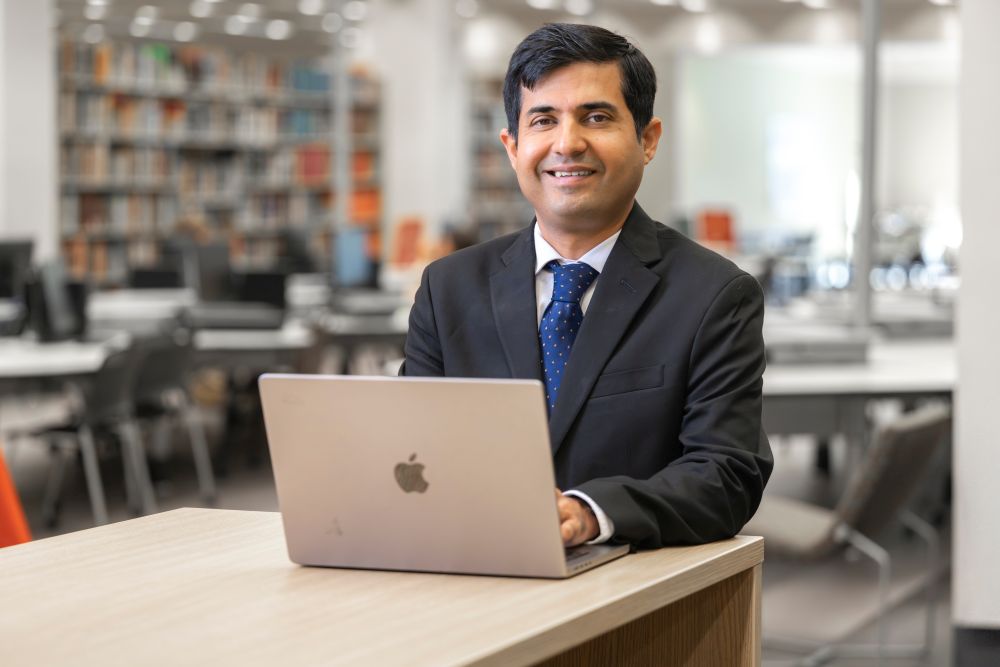
Sayyed Fawad Ali Shah, an assistant professor in the School of Communication & Journalism, is helping shape the future of journalism by studying the challenges reporters face, from threats to press freedom to the mental health toll of the job. That work has earned him Auburn University’s Emerging Creative Research and Scholarship Award.
Shah teaches reporting and multimedia journalism, bringing nearly a decade of on-the-ground experience into his classes. Before entering academia, he reported on war, conflict, crime, education, health and climate for media outlets around the world. Those experiences help him show students how classroom skills translate into real-life reporting.
His research focuses on some of the most urgent issues in journalism today, including shrinking press freedoms, the rise of new technologies and the physical and emotional strain placed on reporters. His work has been cited more than 500 times — including in three United Nations policy papers — and published in journals such as Health Communication; Digital Journalism; Journalism Studies; Journalism: Theory, Practice, and Criticism; Vaccine and Health Education & Behavior. He also serves as co-chair of the Health Communication Working Group of the International Association of Media and Communication Research.
“People need reliable and accurate information to make informed decisions. Strong journalism is important for our democracy.” ~ Sayyed Fawad Ali Shah
Assistant Professor, School of Communication & Journalism
For Shah, receiving Auburn’s Emerging Creative Research and Scholarship Award reinforces why this work is so important.
“When I started my career as a journalist, people would just focus on the physical safety of journalists without realizing the stress and the trauma involved. You couldn't discuss mental health issues in the newsroom. Everyone had the fear that if you talked about it, you would be considered weak,” Shah said. “People are now paying attention to the mental well-being of journalists, and they are talking more about it.”
His research also explores health communication, particularly how communities understand vaccine messaging in areas dealing with conflict, misinformation and mistrust.
“I saw firsthand people resisting health initiatives,” Shah said when describing his time covering conflict zones in Pakistan. “We need to understand the dynamics of how people receive messages about health and well-being.”
One of the key strengths of Shah’s work is how it leads to real-world impact. He trains journalists and students in Pakistan, Afghanistan, Germany and beyond on safety, trauma literacy and cross-cultural communication. At Auburn, he works with colleagues to study the stresses facing U.S. journalists and contributes to projects aimed at strengthening local news ecosystems as more communities confront news deserts.
Auburn’s supportive and collaborative environment makes this work possible while giving students hands-on research opportunities.
“Auburn is just an amazing place to work. It's really a collaborative environment and people are really welcoming,” Shah said. “And we have great students. We get research assistants who help us with our projects. A recent top paper award I received was co-authored with one of my graduate students.”
As the journalism industry continues to shift, Shah’s research and mentorship help prepare students to enter the field with purpose and confidence.
Learn more about the 2025 Faculty Awards.
Tags: Communication and Journalism Faculty Research

Related Articles
-
Auburn philosophy professors discuss ethics of AI
Assistant Professor Rachel Rudolph and Associate Professor Elay Shech discuss ethical questions society will need to confront about evolving artificial intelligence. -

Cell phone bans could improve overall school environment
As schools and statehouses grapple with cell phone use in the classroom, researchers in the College of Liberal Arts have evaluated a promising cell phone ban policy that benefits students and teachers alike. -
Auburn journalism students reflect on opportunity to cover March Madness
As the NCAA Men’s Basketball Tournament shifts to New Orleans for the Final Four this weekend, a group of Auburn University journalism students reflected on the chance to experience March Madness firsthand. -
Shelley named American Society for Aesthetics vice president
Professor James Shelley will serve a two-year term as VP for one of the nation's premier philosophical societies. -
CAH Faculty Writing Retreat creates space for CLA public scholars
For two days, faculty from across the College of Liberal Arts gathered at Pebble Hill to work and connected with scholars in other disciplines. -

NYT: F.D.A. Proposes New Food Labels to Detail Sugar, Fat and Salt Levels
Associate Professor of History Xaq Frohlich discusses the FDA's new proposed food labels in The New York Times.