Craft and community: Actor Michael O’Neill teaches Theatre & Dance students to own their auditions
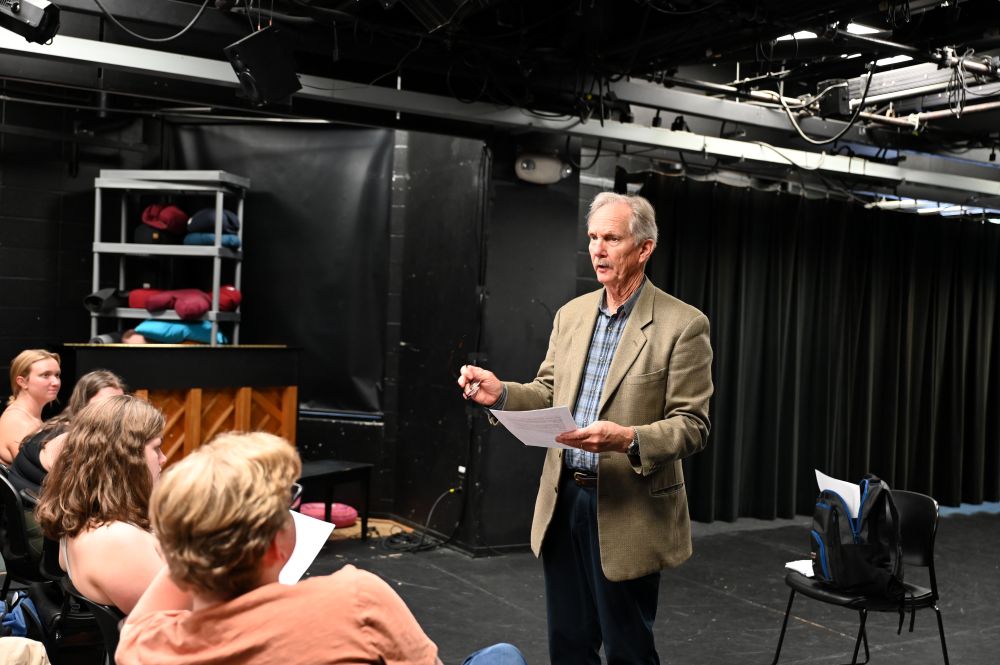
You’ve seen character actor Michael O’Neill onscreen for 45 years, in everything from “Transformers” and “Seabiscuit” to “The West Wing” and “Grey’s Anatomy.” He’s known for his iconic mustache, the life he breathes into characters and engagement with his alma mater, Auburn University.
This spring, O’Neill led realistic auditioning workshops for Theatre & Dance students, which included the anxiety of having directors stare you down from the other side of the table.
“I stress all the time: these auditions are yours,” O’Neill said. “If you feel compelled to add a line, add a line. If a mistake happens, watch how quickly they lean in to watch. Don’t be afraid of a mistake. Don’t be afraid of the flow. It’s your audition and what you want to do with it is what matters.”
An actor can control their performance, but not what’s happening on the other side of the table. O’Neill encourages students to take a seat on the director’s side to learn how to navigate auditions from a new perspective.
If an actor is not chosen for a role, it’s likely that they just don’t fit with other key elements of the production. The director also sees who doesn’t want the job, who wants the job too much and who does the work to land a role.
The key, according to O’Neill, is to focus less on pleasing the panel in front of you and more on embodying the character through your performance. When you do that, O’Neill said a good audition is never wasted.
“They have craft. They are coming out with the skill to work on any stage in the country. The question then becomes opportunity,” O’Neill said. “We have a better chance of getting the work if we just take care of our side of the table, because as soon as you do that, you have agency. The great temptation is to try to figure out what they want, and it's a pitfall. It's much better to determine what you want and give it to them. It's a gift.”
O’Neill also provided students with information about the state of the industry. Production is moving away from Los Angeles and New York, and into locations that are more affordable, such as Atlanta, Dublin, Prague, London and Spain.
In each city, he said an actor needs to do their research, see who’s hiring through the film commissions and understand the progression from background to leading roles. When he started auditioning, O’Neill said he’d land one job for every 40 auditions. Today, it’s one in five.
Self-taped auditions are also more popular than the in-person environment. O’Neill urged students to find someone who they trust to give them honest feedback. Craft and community are the two things the actor can control, and O’Neill said it’s important to take care of both.
Even taking steps to increase your odds of landing work, luck is a major factor for the young actor. Rejection is inevitable, and it stings. O’Neill said the only cure is auditioning until it’s no longer precious, taking care of yourself and having a spaghetti dinner with a trusted friend after something lets you down.
“You need to go into the room with self-love, self-respect, absence of judgment, because in the absence of those things, we beat ourselves up,” O’Neill said. “They have a community here. They know how to support one another, but they'll have to find it when they go out in the world. An actor’s mantra is, ‘It’s my fault. I must have done something wrong.’ The truth of the matter is no, you showed up, and that’s the job.”
If the worst happens, and opportunity never knocks, O’Neill said it’s a personal choice to pursue opportunities for work elsewhere. He stressed that casting directors do not define an actor’s worth, so if they find themselves at a crossroads, to look within for the right path to follow.
Acting is expensive, financially and emotionally, but those who pursue it even for a short time will have lived the dream for longer than most people ever will. O’Neill said the great thing about a theatre education is that nearly everything is a performance, and you can still find meaningful work with the skills you’ve honed.
“It's hard because you can't help but think somehow or another you failed. You didn't. You had the experience. You gave them the opportunity and they didn't respond,” O’Neill said. “But what do you have? In this education, the most translatable skills for any job imaginable. You can improvise, you can collaborate, you can communicate and you can listen. There's not a business model out there that doesn't value those things.”
When O’Neill graduated with a degree in economics in 1974, he’d seen two shows while the theater was still housed in the Auburn University Chapel. Since then, he’s seen Theatre & Dance acquire expert faculty, students well-trained to enter show business and professional facilities built to host each season.
He and his wife, Mary O’Keefe, have supported scholarships for Auburn students, he’s delivered the commencement address and performed “Alabama Boys” at the Jay and Susie Gogue Performing Arts Center alongside co-writer and fellow actor Thom Gossom.
O’Neill said that even though he didn’t receive a formal acting education at Auburn, the university equipped him with the resiliency to be successful as an actor. He said current students will realize that “in the rearview mirror,” after they’ve found their own success.
“Somebody told me I couldn't do it, and that's when I became an actor,” O’Neill said. “Auburn put something in my internal column that allowed me to withstand the rejection, and I'm fully aware of that. That’s exactly what helped me survive.”
Learn more about Auburn Theatre & Dance at the College of Liberal Arts website.
Tags: Theatre and Dance Students Alumni

Related Articles
-

Law & Justice student creates community through leadership
Law and Justice junior Maggie Haggerty found her place at Auburn through her involvement in student organizations such as Mock Trial. Now she’s creating community for students like her by leading the Women in Law organization. -

Auburn Theatre & Dance students reach new heights in aerial fabrics course
Aerial fabrics is an art form in which a performer maneuvers mid-air on two long strips of fabric that hang from the ceiling, which literally elevates students' performances. -

Auburn speaker series continues dialogue about importance of humanities in health care
The Medical and Health Humanities Speaker Series brings together faculty, staff, students and community members to introduce the importance of the humanities in health care. -

Political science senior Joanne Kim on fast track to become U.S. diplomat
Kim will start her career in international diplomacy immediately following graduation through the 2024 Charles B. Rangel International Affairs Graduate Fellowship Program. -

Musical theatre maestro Adam Gwon encourages Auburn student performers to embrace authenticity
Auburn Theatre & Dance students performed for and learned from Adam Gwon, award-winning musical theatre writer, composer and lyricist. -

WATCH: Journalism-Sports Production students’ award-winning documentary ‘RivAUlry’
“RivAUlry” is a behind-the-scenes look at the Auburn University Men’s Club Soccer team and their competition with the University of Alabama, which recently won a Student Production Award for Best Sports Program.