Auburn Art unveils 50-foot mural honoring Poarch Creek Indians
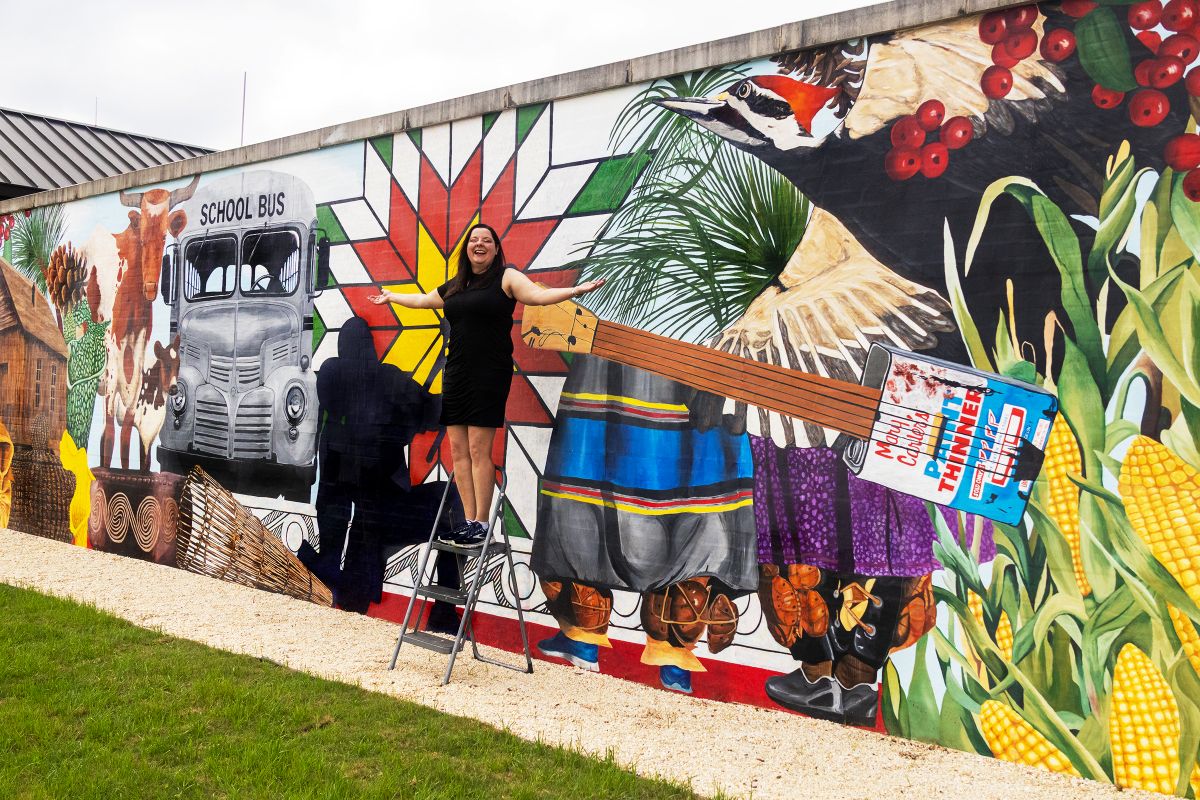
The Poarch Creek Indians (PCI) now have a permanent art installation celebrating their history and culture after Auburn students and faculty completed the university’s largest academic mural project.
Art Professor Wendy DesChene has led Auburn’s mural painting class for 20 years. She said in addition to this being the biggest project she’s done through her course at Auburn, it’s also especially close to her heart as a Canadian Métis Nation person. DesChene worked directly with PCI tribal leadership to make sure it included everything they wanted to see.
“It’s a symbol of hope, and it’s a symbol of their resilience, and it’s a symbol of their future all in one. The fact that they were able to overcome so much, yet maintain their culture, it’s a wonderful story to paint,” DesChene said. “This is basically a gift from the school to them for being such great partners to us for all these years and I want them to be proud, because it’s their story.”
The Poarch Creek Indians are descendants of the original Creek Nation and the only federally recognized tribe in the state of Alabama. PCI avoided removal from their ancestral land, and have lived in Poarch, Alabama, for two centuries.
Their history is defined by purpose, community, strength and spirit. Tribal Historic Preservation Officer Billy Bailey said each part of the mural makes up part of their unique story for all to see and celebrate.
Every part of the mural was chosen for a reason: to reflect our history, our culture and our connection to this land. We didn’t want to focus on just one moment – we wanted it to show a timeline of our people, where we come from, what we’ve been through and what we still carry forward today. It was important to us that it show who we are through our lifeways, not through a logo or words. ~ Billy Bailey
Tribal Historic Preservation Officer, Poarch Band of Creek Indians
The mural features symbols of PCI culture, location and history. The collage includes references to quilting, ribbon skirts, moccasins, a fishing basket, shakers made from turtle shells used in traditional dance and a father teaching their child stick ball – a traditional sport passed down through generations.
A depiction of a Civil Rights Era bus in black-and-white symbolizes the tribe’s fight for desegregated schools and a painting of a guitar made from a turpentine can is based on a real artifact made by a tribal elder currently on display at the PCI museum.
Throughout the piece, the tribe’s colors – green, red and yellow – appear alongside flora and fauna native to the area, including corn, Yaupon Holly, cows and a woodpecker taking flight.
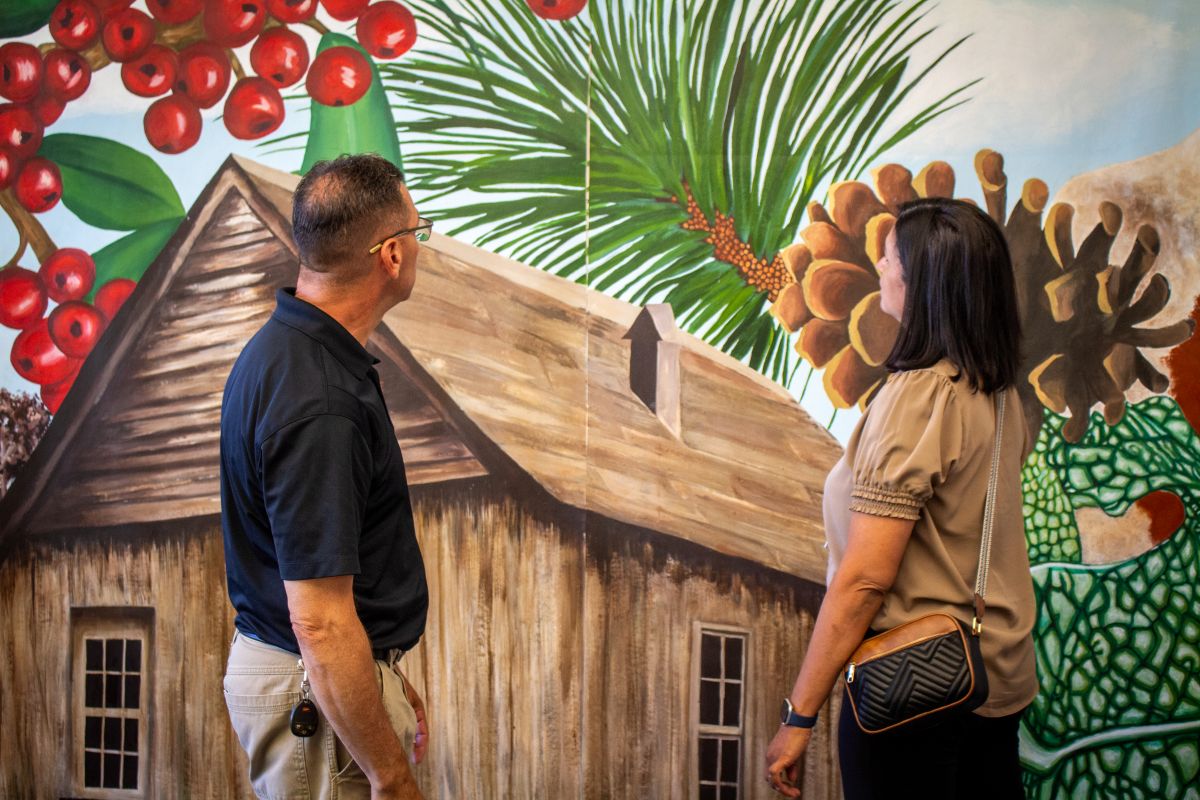
“Our heritage and culture, through assimilation, has been watered down,” said NAGPRA Technician Clayton Coon. “I hope these small visuals could continue to strengthen what remains and encourage youth to reach out, learn more and stay involved in their heritage and culture.”
DesChene and her students completed the massive mural by sectioning it out into several panels that occupied every wall in Biggin Hall’s third floor. Students with less experience painting started with patterns and shapes, gaining confidence and skill as they worked through the semester to move on to more complex work.
Recent painting graduate Kayti Reaves helped facilitate the effort as a student worker. She said the project helped students learn how to work together, accept creative feedback and hone technical skills while creating a piece that matters so much to the community.
“There's a ton of people in here who have never painted before, and it's a great opportunity to learn, and with this one, our professor made the design with the community,” Reaves said. “Painting is a labor of love because you're putting a lot of time and dedication into something and into representing it. We want the people that we're giving it to to feel represented and that we cared and put our whole effort into it.”
In May, the mural was installed outside the Poarch Creek Indians’ new administrative building in Atmore, Alabama. It’s located close to the PCI Museum and Welcome Center, which is free and open to the public. The museum invites people to experience the tribe’s history firsthand through exhibits on how early Creek Indians lived, traditional Creek art and original copies of the Petition for Federal Recognition from 1980.
The mural’s placement ensures that anyone living in or visiting the ancestral land will be welcomed with a visual celebration of the tribe’s rich history and culture.
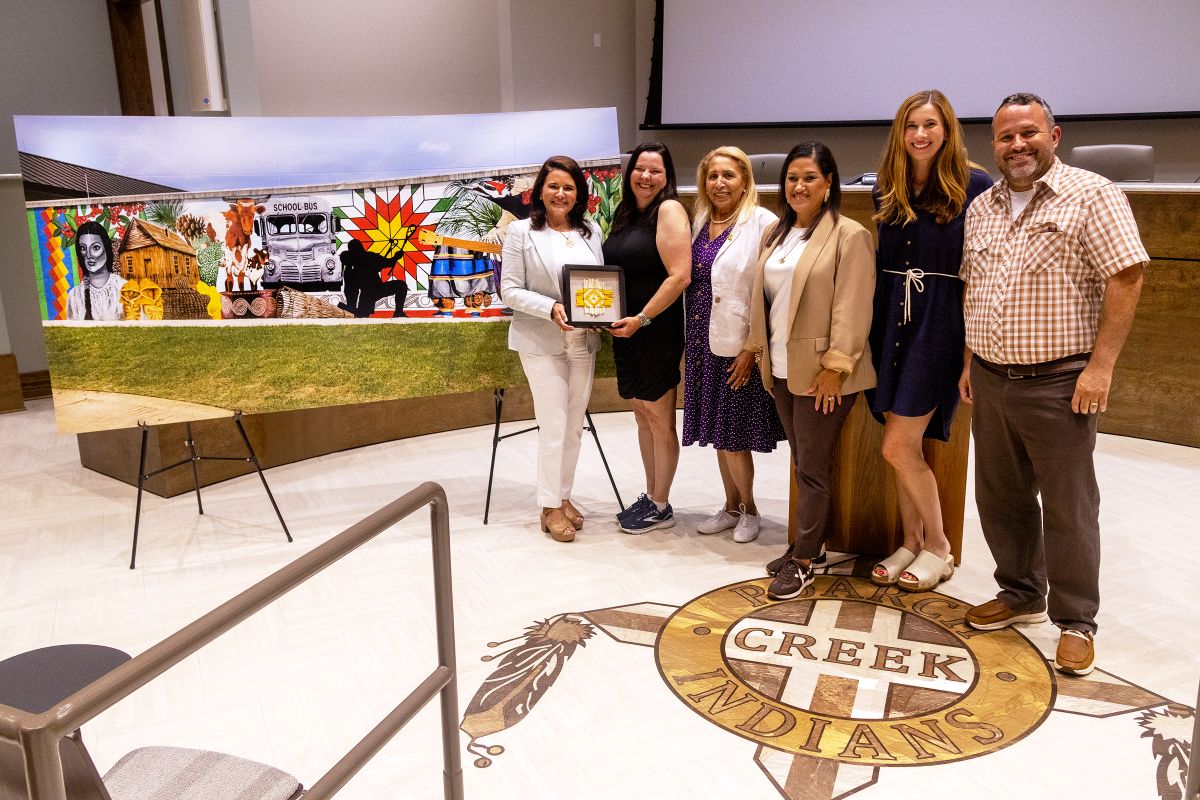
“What I'm hoping is that our people will identify with at least one portion of this mural, because each one of these is a segment of time,” said Tribal Historic Preservation Specialist Brandy Chunn. “We have multi-generational people within the tribe who each have their own connection to a certain portion. There’s so much that has its own story.”
The mural project was supported by grant funding through Auburn University Outreach and in partnership with the Caroline Marshall Draughon Center for the Arts & Humanities in the College of Liberal Arts.
Commissions and grant funding support DesChene’s mural painting course, which invites students from every major interested in painting to collaborate with their peers to create a lasting, public impact through art.
“You’re working on something so much larger than yourself,” DesChene said. “There are no pre-requisites on the class because we want to make sure anybody who wants to work on a mural can. These projects, in addition to being very democratic and cool, gives them an opportunity to learn how to work together.”
Find more information about opportunities in the Department of Art & Art History at the College of Liberal Arts. To learn more about the Poarch Creek Indians, plan a visit to the PCI Museum and Welcome Center.
Tags: Art and Art History Center for the Arts and Humanities Arts and Culture Faculty Community, Outreach and Engagement

Related Articles
-

Auburn piano professor celebrates solo album's international release
Ike and Rhonda Scott Endowed Professor of Piano Jeremy Samolesky's newest album, "Marjan Mozetich: The Complete Piano Music," is available on all streaming platforms. -

Shaped by Auburn: Retired faculty member, alumnus supports the next generation of the Auburn Family
Many of Economics Professor Emeritus Donald Street's stories are shaped by Auburn, and he's committed to giving back to the university to help provide opportunities for future members of the Auburn Family. -

Teaching Selma: Auburn University faculty host civil rights education workshop for K-12 teachers
“Bloody Sunday, Selma and the Long Civil Rights Movement” invited teachers from across the country to explore understudied people and places of the civil rights movement. -

Auburn Theatre & Dance sets stage for resilience with 2024-2025 season
The Department of Theatre & Dance hopes to cultivate conversations about resiliency through elemental stories of strength and character in its upcoming season. -

Six CLA faculty and staff members to be recognized with Auburn Author Awards
Six faculty and staff members from Auburn University’s College of Liberal Arts will be recognized at the 2023 Auburn Author Awards ceremony on April 11. -

Auburn University professors release new book exploring the mystery of color
Professors Michael Watkins and Elay Shech provide an opinionated and selective introduction to key philosophical issues surrounding the nature of color.