Law & Justice professor inducted into first-ever Fellowship to Combat Campus Antisemitism
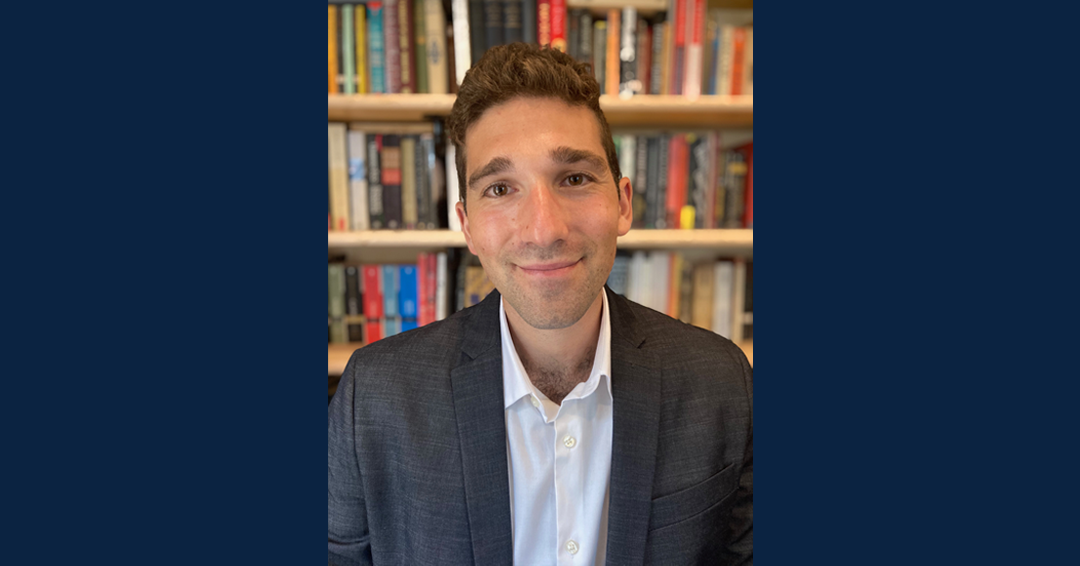
Ariel Liberman, assistant professor of law and legal studies in the Department of Political Science, will represent Auburn University in a new national initiative to study and stop antisemitism in higher education.
The Teaching Fellowship to Combat Campus Antisemitism – hosted by Touro University in association with the National Jewish Advocacy Center – selected its first faculty cohort from a national pool of applicants based on their expertise and potential for intellectual leadership in the field of antisemitism studies.
From across the country, fellows will come together to assess the realities of antisemitism and hate on campuses, workshop approaches, brainstorm courses, share research, and develop best practices for combating hate on U.S. college campuses to be shared widely with faculty across the country.
“I am deeply honored and very excited,” Liberman said. “Through this invitation, Auburn University gets a spot center-stage in the fight against antisemitism on a national level. Given how this sort of hate has featured so prominently in the news, in communities across America, it’s amazing that we can come together in the interest of finding solutions.
“The academic study of antisemitism has, for a long time, been very theoretical and abstract, especially in America. The country’s founding ideas of religious tolerance and freedom created a safer environment for Jewish people than in other countries, and the antisemitism commonplace across Europe seemed a comparatively distant idea to American Jews for so long.”
But Liberman said the need for more pointed, unform national scholarly engagement became clear when the events of Oct. 7, 2023, and the start of the Israel-Hamas War led to a nearly unprecedented increase in antisemitic incidents in the U.S.
“These incidents are frequently cited to take place on college campuses,” Liberman said. “And this, in part, has been driving faculty here at home to consider differently the topic of ‘antisemitism’ and acknowledge a general need for more Jewish-identity centered scholarship as an approach to addressing very real threats against the Jewish people."
"The challenge is visceral and new. The fact that antisemitism is reported in the college space is an especially huge problem. Colleges have been and should be spaces for inquiry and connection. There is no place for hatred or ostracization. A Jewish student should never feel unsafe in the classroom on account of identity."
Liberman said Auburn is in a different place than many other peer institutions represented at this fellowship.
“Auburn is safe and supportive of its Jewish faculty, staff and students,” Liberman said. “At Auburn, students rarely, if ever, contend with the same challenges as one may see elsewhere.”
He said his role in the fellowship is to help share what Auburn has done right in cultivating positive, proactive community which supports all its students, including its Jewish minority.
“This is not a campus where you run into antisemitism and hate regularly,” Liberman said. “Personally, I feel very blessed to be at Auburn as a scholar doing the work that I do – I am encouraged and supported by my peers on the faculty and our broader Auburn community.”
Liberman, who has given talks on antisemitism through the Auburn Hillel, serves as a leader in the Jewish community in Auburn and discusses some of these topics in the law courses he teaches, emphasized that it’s the “Auburn students that are really something.” He said there’s a characteristic intellectual curiosity and a desire to support one another at Auburn.
He said the fellowship is a golden opportunity to focus on work that could translate into material which prepares students and faculty to lead with truth, compassion and understanding.
“What I see is we may now be able to craft a rigorous, research-backed toolbox – for the Auburn community, or any community – for talking intelligently about antisemitism with their peers and their communities, studying its ins and outs, empowering folks to address hate when they go into their professional and personal lives,” Liberman said. “Antisemitism education is really citizenship education. I want Auburn students, for example, to go and be civic leaders. You can't be leaders unless you know what's going on around you, how others outside your community are being impacted by current events, and understand why that should matter to you.”
This latest fellowship is the most recent honor Liberman earned for his work at the intersection of law and religion, antisemitism, education and democracy studies. In years past, he has been inducted as a faculty fellow at the Center for Jewish Legal Studies, fellow at the London Centre for the Study of Contemporary Antisemitism and senior fellow in law and Judaism at the Center for the Study of Law and Religion.
This spring, he delivered a lecture exploring the path to an effective federal antisemitism education mandate at the prestigious Law and Antisemitism Conference in New York City and will present again at the International Congress of Law and Religion in Palermo, Italy, this fall.
Here at Auburn, Liberman teaches in the College of Liberal Arts’ Law and Justice (LAWJ) program.
“It is such a joy to be able to work with our LAWJ students,” Liberman said. “Talk about citizenship education! The ideas we explore – like the federal courts, legal philosophy, constitutional law, law and society – are incredibly important for not just aspiring lawyers, but for any citizen to consider at least in some depth.”
Liberman said the study of antisemitism fits neatly with the LAWJ program’s civic objectives.
“I view this work as an extension of what we study in LAWJ. I’m not interested in the antisemitism problem because this is a Jewish problem, I’m interested in this because it’s actually venomous to democracy and the rule of law,” Liberman said.
"Learning how to combat hate, not just antisemitism, but to challenge any impulse to outcast or mistreat others is important for our systems and our American pluralistic experiment to work. Every student has a duty and responsibility to consider this, whether hate is directed against Jews or against anybody."
Learn more about the Law & Justice program at the College of Liberal Arts website.
Tags: Political Science Faculty Research

Related Articles
-

Law & Justice student creates community through leadership
Law and Justice junior Maggie Haggerty found her place at Auburn through her involvement in student organizations such as Mock Trial. Now she’s creating community for students like her by leading the Women in Law organization. -

Tech-savvy yet dissatisfied: Auburn student researches attitudes toward post-pandemic remote work
Psychology senior Emily Findlay examined students’ attitudes toward remote work following the COVID-19 pandemic, revealing surprising insights into their preference for in-person engagements. -

'Things You Didn't Know You Didn't Know' about suicide prevention
In this episode of the TYDKYDK podcast, Assistant Professor of Sociology Tierra James walks us through her work in suicide prevention. -

Mock Trial Competition Teams compete in fall tournaments
Auburn's teams finished among the top in the Davidson Invitational and Kennesaw State's Owl Classic. -

Professor Melissa Blair answers: Was the Revolution revolutionary for women?
Blair, professor and chair of Auburn’s Department of History, delivered a presentation that emphasized how women were not passive bystanders to the Revolution. -

Collin Perciballi, '11, a focus on Italian propelled his career in economic development
A study abroad experience at Auburn led him to pursue graduate study in Italy.